
Beyond the Price Per Roll: The Hidden Cost of Standard Tape in High-Volume Manufacturing
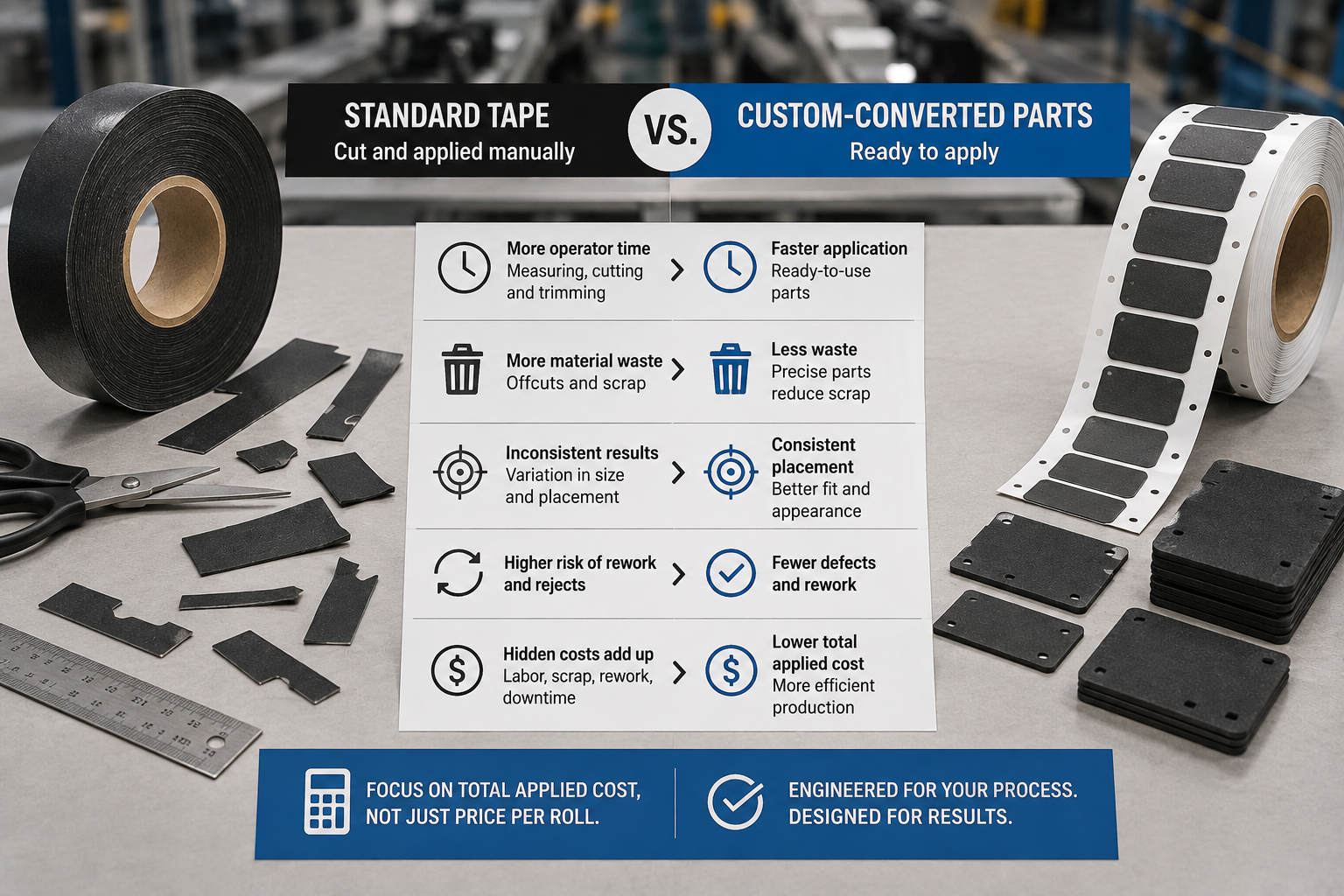
When evaluating industrial tape, price per roll is often one of the first numbers purchasing teams look at.
But in high-volume manufacturing, the lowest-cost roll is not always the lowest-cost solution.
Standard tape may require operators to measure, cut, position, and remove liners manually. Each of those steps adds labour and introduces the possibility of variation.
Over thousands of assemblies, small inefficiencies can become significant.
Where the Hidden Costs Appear
Using standard rolls can contribute to:
Excess material from hand cutting
Inconsistent part dimensions
Placement errors
Longer assembly cycle times
Additional operator handling
Rework and rejected parts
Line interruptions caused by difficult application
These costs may not appear on the tape invoice, but they still affect the total cost of production.
When Converting Can Improve the Process
Custom-converted adhesive components can be supplied in repeatable shapes, sizes, and presentation formats designed around the assembly process.
Instead of cutting tape at the workstation, operators or automated equipment can apply a finished component that is already prepared for the application.
Die-cut parts can also include tabs, liners, registration features, or specific spacing to simplify handling and improve placement consistency.
For engineering teams, this can reduce process variation and help improve repeatability.
For purchasing teams, it creates a more complete way to evaluate cost. Rather than comparing only the price per roll, it is worth considering the total applied cost, including labour, scrap, downtime, and rework.
In the right application, a converted adhesive component may cost more per piece than material cut from a standard roll—but still reduce the overall cost of manufacturing.
Using standard tape in a high-volume assembly process? Contact Muir Tapes & Adhesives to review your application, material usage, labour, and production requirements. We can help determine whether a custom-converted adhesive solution could improve efficiency and reduce total applied cost.