
Custom Die-Cut Adhesives for Medical Devices: Moving Beyond the Roll
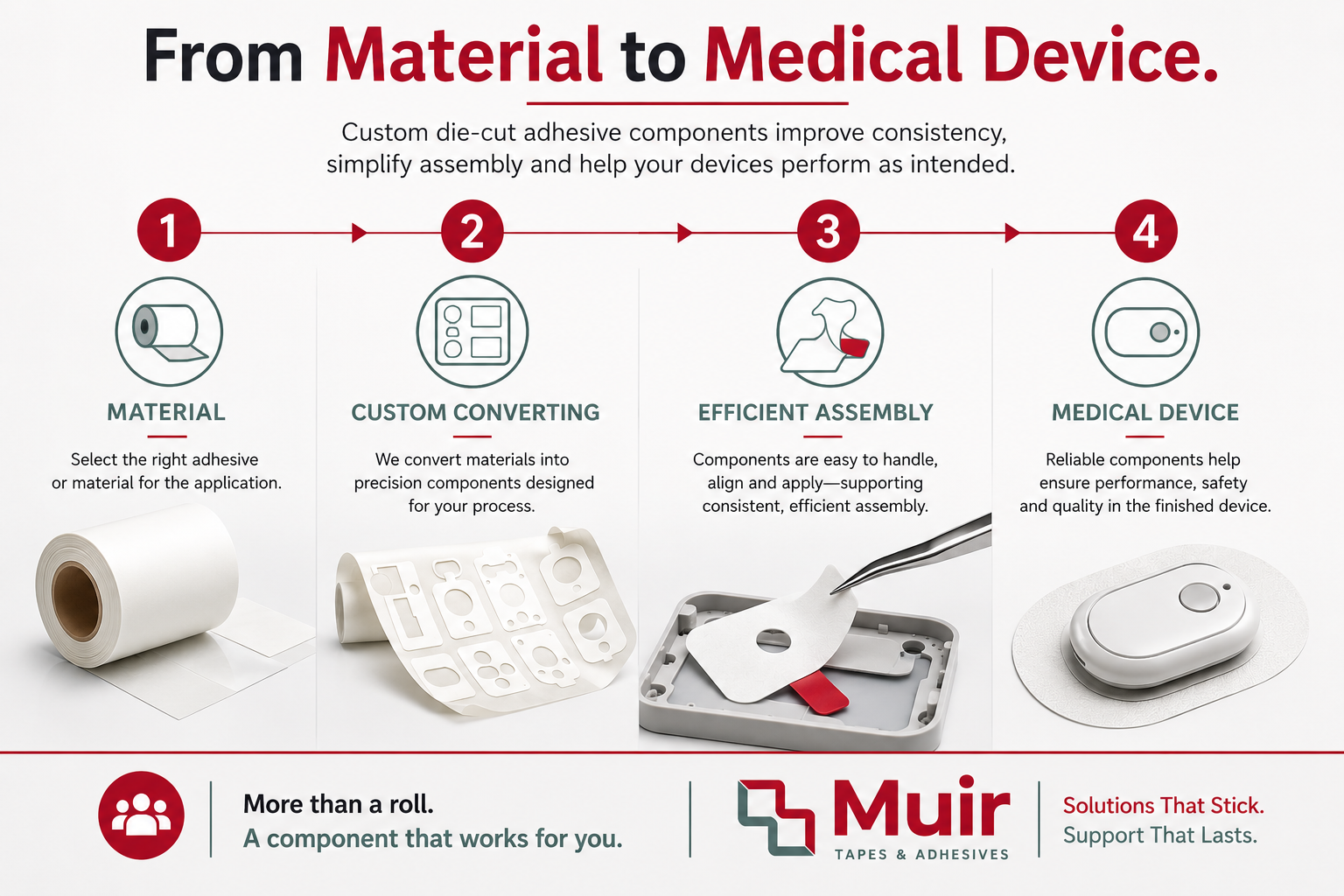
Selecting the right adhesive is an important step in medical device design, but choosing the material is only part of the equation.
Manufacturers also need to consider how that adhesive will actually be incorporated into production. Does it need precise alignment? Will operators remove liners or position components manually? Could the process eventually be automated? And what happens when production moves from a prototype to thousands - or millions - of parts?
This is where custom converting can make a significant difference.
Turning Adhesive Material into a Finished Component
Pressure-sensitive adhesives, films, foams and other flexible materials can be converted into components designed specifically for an application.
Custom converting can include:
Die-cut or kiss-cut shapes
Tabs or extended liners for easier removal
Laminated or multilayer constructions
Precise openings and registration features
Parts supplied in rolls, sheets or individual pieces
Components configured for manual or automated assembly
Instead of asking an operator to measure, cut and position adhesive during production, the material arrives ready to become part of the assembly.
Improving Consistency and Assembly
Medical devices can contain surprisingly small components, where even minor differences in placement can create challenges.
A custom die-cut component provides a repeatable shape and dimension while making correct positioning easier. Part design can also account for the people - or equipment - that will install it.
Something as simple as adding a pull tab or changing a liner configuration can make a component easier to handle. When multiplied across thousands of assemblies, small improvements can have a meaningful impact on production efficiency.
The objective isn't simply to make the adhesive smaller. It's to make the assembly more repeatable.
Designing with Production in Mind
Custom converting becomes particularly valuable as production volumes increase.
Part spacing, liner selection, roll configuration, orientation and release characteristics can all affect whether an adhesive component works efficiently with manual, semi-automated or automated production.
Material utilization matters too. Medical-grade adhesives, specialty films and engineered foams can represent a significant material cost. Part geometry and nesting can influence how much usable product can be produced from a roll or sheet.
Thinking about these factors during component design can help manufacturers improve efficiency and avoid having to redesign a part as production grows.
Why Involving a Converter Earlier Matters
A common approach is to select the adhesive, finalize the component design and then ask a converter to manufacture it.
Bringing a converting partner into the conversation earlier can create more opportunities.
Material selection, geometry, tolerances, liners, assembly methods and anticipated production volumes can all influence how a component should be designed and manufactured.
Sometimes a small design adjustment can simplify converting, reduce material waste or make assembly easier.
The goal isn't just to manufacture the drawing provided. It should be to understand how the component will ultimately be used and identify opportunities to improve the overall process.
From Material Selection to Manufacturing
At Muir Tapes & Adhesives, we work with manufacturers to look beyond the roll.
Our relationships with leading adhesive and flexible-material manufacturers give us access to a broad range of material technologies, while our custom converting capabilities allow those materials to be transformed into components designed around specific applications.
Whether you're developing a new medical device, evaluating an existing component or preparing for increased production volumes, involving a converting partner earlier can help uncover opportunities that may not be obvious from the material specification alone.
Because sometimes the right solution isn't just finding the right adhesive.
It's designing the right part.
Ready to explore a custom-converted solution for your medical device application? Talk to the Muir team about your application.